Facebook ads for supplements, from your real jar
advrt writes supplement ad angles from your product page and makes Meta ads with your real jar. Meta requires 18+ targeting for health supplements; advrt tests already target 18+.
Free plan: 5 ad generations a month, no card. Nothing spends until you confirm a test.
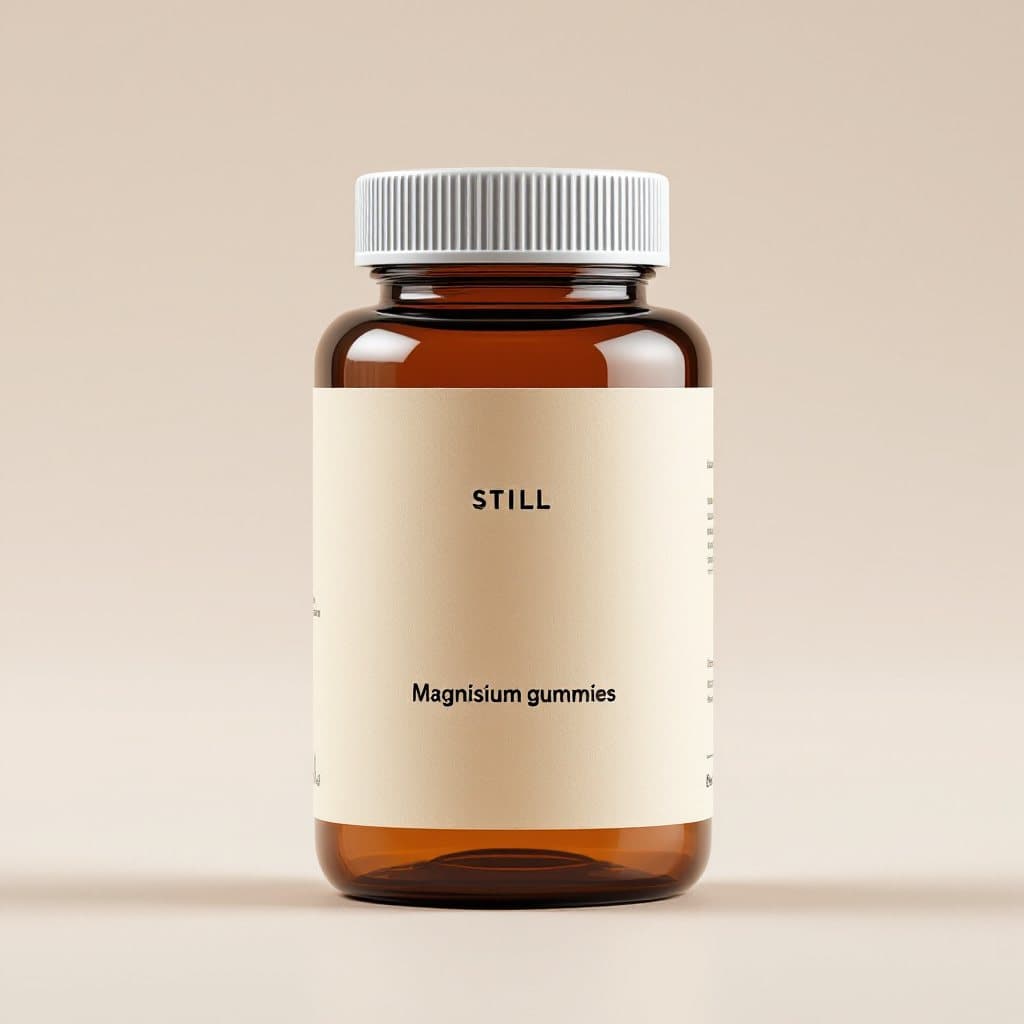
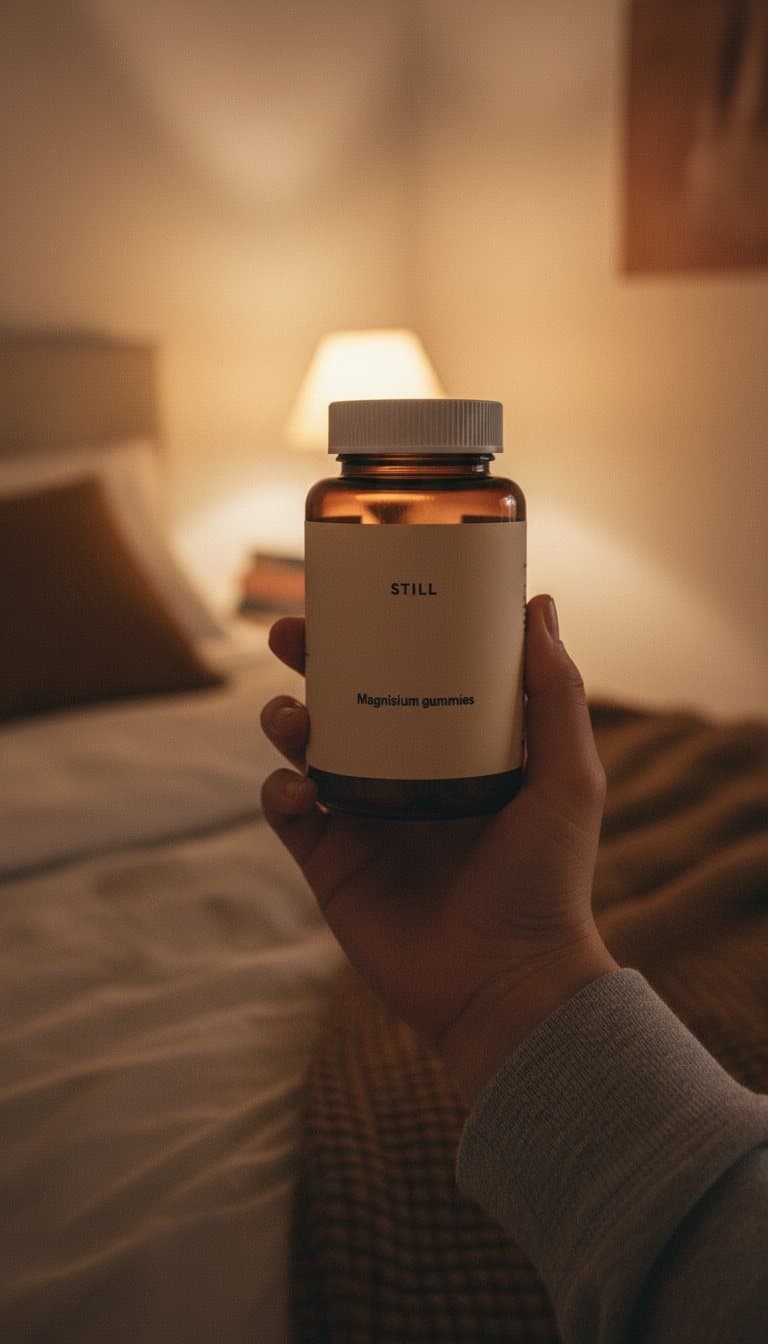
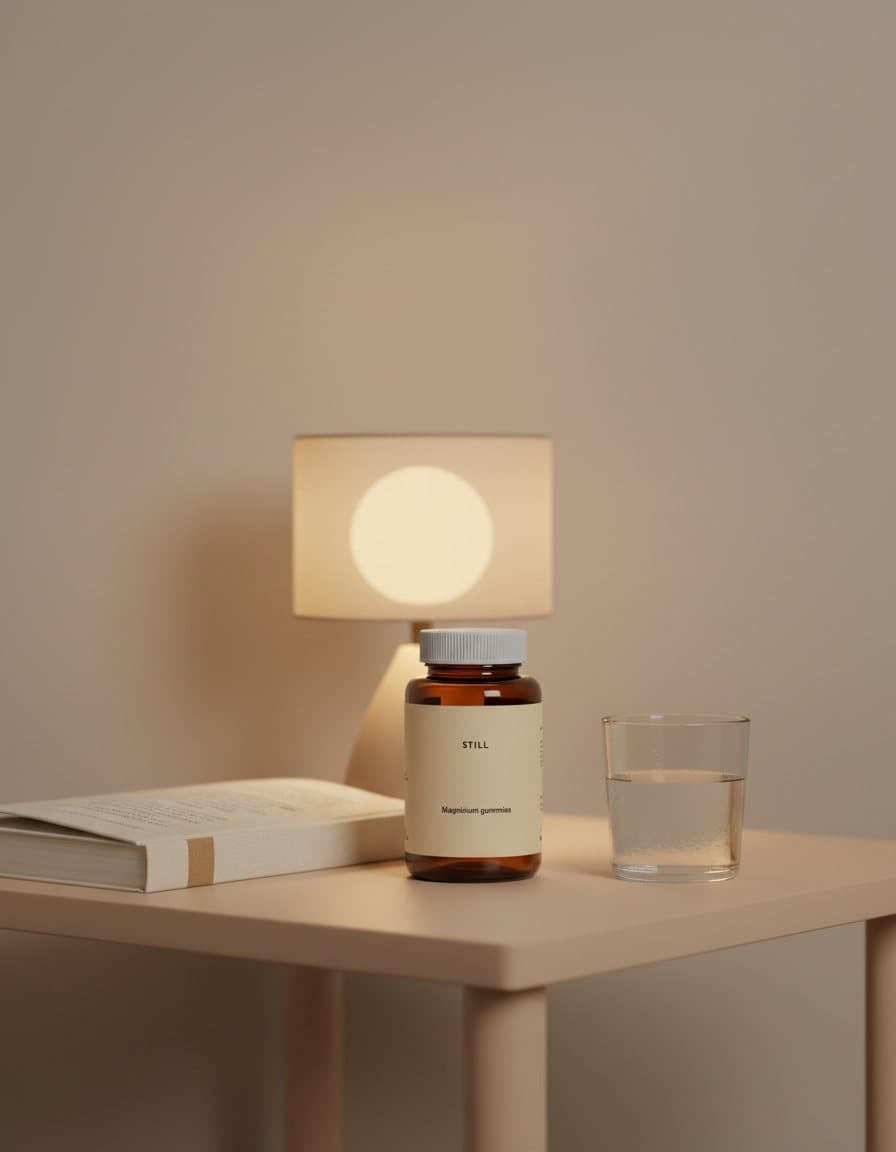

The product photo is an AI packshot of STILL, a made-up brand. The three ads are unedited advrt outputs. The label typo came from the packshot; see below.
In supplement ads, the copy carries most of the policy risk: a cure claim, a timed promise, or a hook that tells the viewer they have a condition. The images are easier. advrt keeps your jar and label by editing your own product photo, and its copy prompt is told never to invent prices, discounts, reviews, certifications or results.
This page covers the angles that work without health claims, Meta's supplement rules as they stand after its July 2026 rewrite (some widely quoted rules no longer appear on Meta's pages), and what went wrong when we made the magnesium gummy ads above.
What tends to work for supplements on Meta
- Ritual angles avoid claims entirely. A jar on a nightstand and a “wind down” headline sell the habit; nothing in the STILL ads above says what magnesium does to your body.
- Meta requires 18+ targeting for “dietary, health, or weight loss or weight gain products”. advrt's live tests target 18+ by default.
- Claims are where ads get rejected: no cure claims for listed diseases, no outcomes promised in a set time without a qualifier, and no copy asserting the viewer's health condition.
- Format beats benefit. “No capsules to swallow” is a product fact; “better sleep tonight” is a timed outcome.
- Budget reality: at Lebesgue's $34.29 Beauty and Health CAC, a zero-sale loser can be called after about $79 per ad.
Six supplement angles that don't depend on a health claim
Mapped to advrt's seven formats. The hooks are examples we wrote; advrt writes its own from your product page and only uses claims that page makes.
Evening ritual
Format: Lifestyle
Placing the product in a moment (lamp, nightstand, water glass) implies use without stating an effect. The STILL lifestyle shot does exactly this.
- Wind down, the easy way.
- Two gummies, lamp off.
What's in the jar
Format: Product hero
Form and dose per serving are facts from your label. Buyers comparing supplements read them first.
- One mineral, one gummy, no fillers you can't pronounce.
- 200 mg per serving. That's the label.
Pill fatigue
Format: Problem and solution
The problem is the format, not the body. That keeps the hook about the product and away from health attributes.
- No capsules. No powder. A gummy.
- Magnesium without the horse pill.
Founder's reason
Format: UGC testimonial
Why the product exists is a story, not a claim. It suits a 9:16 hand-held shot or a short script.
- I couldn't find one without added sugar, so we made it.
Gummy or capsule
Format: Comparison
Compare formats, not outcomes or competitors. It answers a real buying question.
- Same mineral, different way to take it.
Subscribe and save
Format: Offer
Supplements are repeat purchases, so a subscription discount suits the category. Written only when the offer is on your page.
- Subscribe and skip any month.
- Your second jar is on us.
Before you generate anything
- Read the label in your source photo letter by letter before generating anything. Our packshot said “Magnisium”, and every ad kept it.
- Make sure the product page states form, dose and serving size. Ingredient angles depend on them.
- Remove any claim from the page you wouldn't defend in an ad. advrt writes from the page and doesn't check Meta policy.
- If the product is sold for weight loss, plan for Meta's extra limits before you generate: 18+, a stated timeframe for results, no fat-pinching close-ups.
Meta's supplement rules after the July 2026 rewrite
Meta rewrote its Health and Wellness ad standard on 22 July 2026. Several rules repeated across supplement guides now point to pages that no longer exist.
Checked on Meta's own pages in October 2026. advrt doesn't screen ads against these rules. Meta's ad review does: it relies mainly on automated tools, typically finishes within 24 hours, checks the landing page too, and can review ads again after they go live.
- Target 18+.
- Health and Wellness: ads for “dietary, health, or weight loss or weight gain products and services” must be “targeted to people at least 18 years or older”. “General food products, including protein products” are exempt.
- Meta decides what's unsafe, case by case.
- The Drugs and Pharmaceuticals standard bans “potentially unsafe drugs, products or supplements”, “as determined by Meta at its sole discretion”. The old standalone Unsafe Supplements page returned a 404 when we checked in October 2026, so there is no current named list to check against.
- No cure claims for listed diseases.
- The Health and Wellness standard bans claims to “cure, heal, or eliminate” a listed set of incurable or terminal diseases, including diabetes and cancer. Claims about “treating or managing symptoms” are excluded from that ban.
- No timed outcomes or clickbait.
- Also banned: “clickbait tactics in a health, weight loss, or weight gain context” and promises of “specific outcomes within a set timeframe without disclaimers or qualifiers”.
- Don't tell the viewer they have a condition.
- Personal Attributes: Meta allows “New diabetes treatment available” and rejects “Do you have diabetes?” and “Depression getting you down? Get help now.”
- Weight-loss before-and-after: treat it as off-limits.
- Meta's eating-disorder ad standard bans before-and-after weight imagery “not related to the use of a product”, and sends product-related cases to a Personal Health and Appearance policy whose page returned a 404 in October 2026. We found no current Meta page that clearly allows them.
How much a supplement test spends before advrt calls it
We computed this table from the verdict rules in advrt's own code. advrt expects an ad that spent S to make S ÷ CPA purchases at your baseline and tests the real count against that (Poisson, one-sided, 10% significance). An ad becomes a loser once it has spent at least 1.5× CPA and its purchase count would happen less than 10% of the time at your baseline. Each ad stops at 5× CPA as inconclusive.
| CPA level | Loser call at 0 sales | Loser call at 1 sale | Fastest winner: 3 sales within | Spend cap per ad | Four-ad test, worst case |
|---|---|---|---|---|---|
| $34.29 Beauty and Health CAC, Lebesgue | $79 | $133 | $38 | $171 | $686 |
| $25.00 Example | $58 | $97 | $28 | $125 | $500 |
| $60.00 Example | $138 | $233 | $66 | $300 | $1,200 |
Lebesgue groups supplements under Beauty and Health (published 9 March 2026). The $25 and $60 rows are round examples: a single jar, and a first subscription order with a higher acquisition cost. Multipliers: loser at 2.30× CPA with no sales or 3.89× with one; winner with 3 sales by 1.10× CPA. Assumes each ad's daily budget is under 5/3 of CPA; above that, the cap becomes three days of budget.
What the table means
The written rule for a winner is at least 3 purchases and a CPA at least 15% better than your account. The statistics set a higher bar: to win by the spend cap, an ad needs 9 sales on 5× CPA of spend, a CPA about 44% below your baseline. An ad that's 20% better will usually end inconclusive. That's deliberate: small budgets can't separate small differences, and advrt would rather say so than guess.
Purchase verdicts need at least 10 purchases in your account's last 30 days. Without them, advrt judges click-through rate instead: 1,000+ impressions and a CTR at least 20% above or below your baseline.
What we saw making the ads above
The STILL packshot first came back as a blank black frame. The three edits built on it then invented three different products: a blue bottle, a candle jar and a different jar. Edit models only preserve what's in the reference image. We regenerated the base photo and reran the ads you see above.
Now read the label. It says “Magnisium gummies”. The packshot model misspelled it, and all three edits faithfully kept the typo, because the preservation prompt tells them not to change packaging text. It cuts both ways: advrt won't redesign your label, and it won't fix one either. For supplements, where the label is regulated copy, check the source photo before you generate anything.
Method: one AI packshot per product (Flux Pro 1.1, 1024×1024), then advrt's image path (Nano Banana edit) for each ad, every prompt starting with advrt's product-preservation instruction: same shape, colours, materials, label, logo and packaging text.
advrt, UGC creators, a photoshoot or a generic AI tool for supplements
| Criterion | advrt | UGC creators | Product photoshoot | Generic AI ad generator |
|---|---|---|---|---|
| Cost | Free plan: 5 generations a month. Basic $19.99/mo adds live Meta tests; Pro $49/mo. Ad spend is paid to Meta separately. | From $99 per video with usage rights at Billo; from $89 at soona | soona: $39 per photo plus a $149 studio pass per booking; Squareshot subscriptions from $1,500/month with a 3-month minimum | AdCreative.ai from $39/mo for 20 credits; Creatify from $15/mo (monthly billing) |
| What you get | Claim-grounded angles, Meta copy and image ads with your real jar, plus 18+ live tests | A person taking the product on camera; claims are whatever the creator says | Exact label and jar, in studio or styled sets | Templates and AI scenes; claim handling varies |
| Product accuracy | Preserves your label, typos included | Exact | Exact | Varies by tool |
| Live test on Meta | Yes, on Basic: one ad set per creative, equal budgets, verdicts against your own account | No. You run and judge it | No. You run and judge it | Varies by tool; check whether it judges results |
| Main tradeoff | Doesn't check Meta policy; Meta's review does | Creators ad-lib health claims you then have to cut | No angle or copy work, and no testing | You still need to judge which ad actually sold |
Third-party prices from each company's own pricing page, checked October 2026. Prices change; check before you buy. advrt prices come from its live plan settings.
Questions supplement brands ask
- Do supplement ads on Facebook have to target 18+?
- Yes, for dietary, health and weight-loss or weight-gain products, under Meta's Health and Wellness standard. General food products, including protein products, are exempt. advrt's live tests target 18+ by default.
- Which supplements does Meta ban?
- Meta's Drugs and Pharmaceuticals standard bans potentially unsafe supplements “as determined by Meta at its sole discretion”. The older page with a named ingredient list returned a 404 in October 2026, so there's no current official list to check against.
- Can I say my supplement helps with sleep or stress?
- Meta's rules ban cure claims for a listed set of serious diseases, clickbait in a health context, and timed outcomes without a qualifier. A general benefit statement is not on Meta's banned list, but your local advertising law still applies. advrt's ritual and format angles avoid the question entirely.
- Why does my supplement ad keep getting rejected?
- Check three things: copy that implies the viewer has a condition, a promised result in a set time, and the landing page. Meta's review looks at images, text, targeting and the page the ad links to.
- Can advrt make UGC for supplements?
- advrt makes UGC-style stills and 8-second image-to-video clips with your real jar. It doesn't make talking creators with voice yet. That gap matters less here than elsewhere, since a scripted creator is where unapproved claims usually creep in.
- What is a good CPA for supplement brands on Meta?
- Lebesgue's Facebook benchmark for Beauty and Health stores is $34.29 CAC (March 2026). Subscription brands often accept a higher first-order CPA. advrt judges each test against your own account's last 30 days.
advrt for your kind of team

DTC & Shopify
Founders and growth leads running Shopify brands on Meta.

Scaling ecom
Growth leads at ecommerce brands with a lean in-house creative team.

Solo founders
One-person stores and side projects selling a physical product.
Other industries
Pricing
- Free $0/mo. See your own product in real ads. No card.
- Basic $19.99/mo. Launch tests on Meta and keep the winners.
- Pro $49/mo. For brands and agencies testing every week.
Sources
- Meta: Health and Wellness ad standard (updated 22 Jul 2026)
- Meta: Drugs and Pharmaceuticals
- Meta: Privacy Violations and Personal Attributes
- Meta: Suicide, Self-Injury and Eating Disorders (ads)
- Meta: Introduction to the Advertising Standards
- Meta: Fraud, Scams and Deceptive Practices
- Lebesgue: Facebook benchmarks by industry (9 Mar 2026)
- Billo: how Billo pricing works (9 Oct 2026)
- soona pricing
- AdCreative.ai pricing
- Creatify pricing
Make your first supplement ad from a product link.
Paste your product page and see ads with your real product in them. Free plan: 5 ad generations a month, no card.