Beauty product ads from your own packaging photos
advrt makes Meta ads for makeup and lip products from your product page and real packaging. Shades on skin are generated, so check them. Makeup is exempt from Meta's 18+ rule.
Free plan: 5 ad generations a month, no card. Nothing spends until you confirm a test.
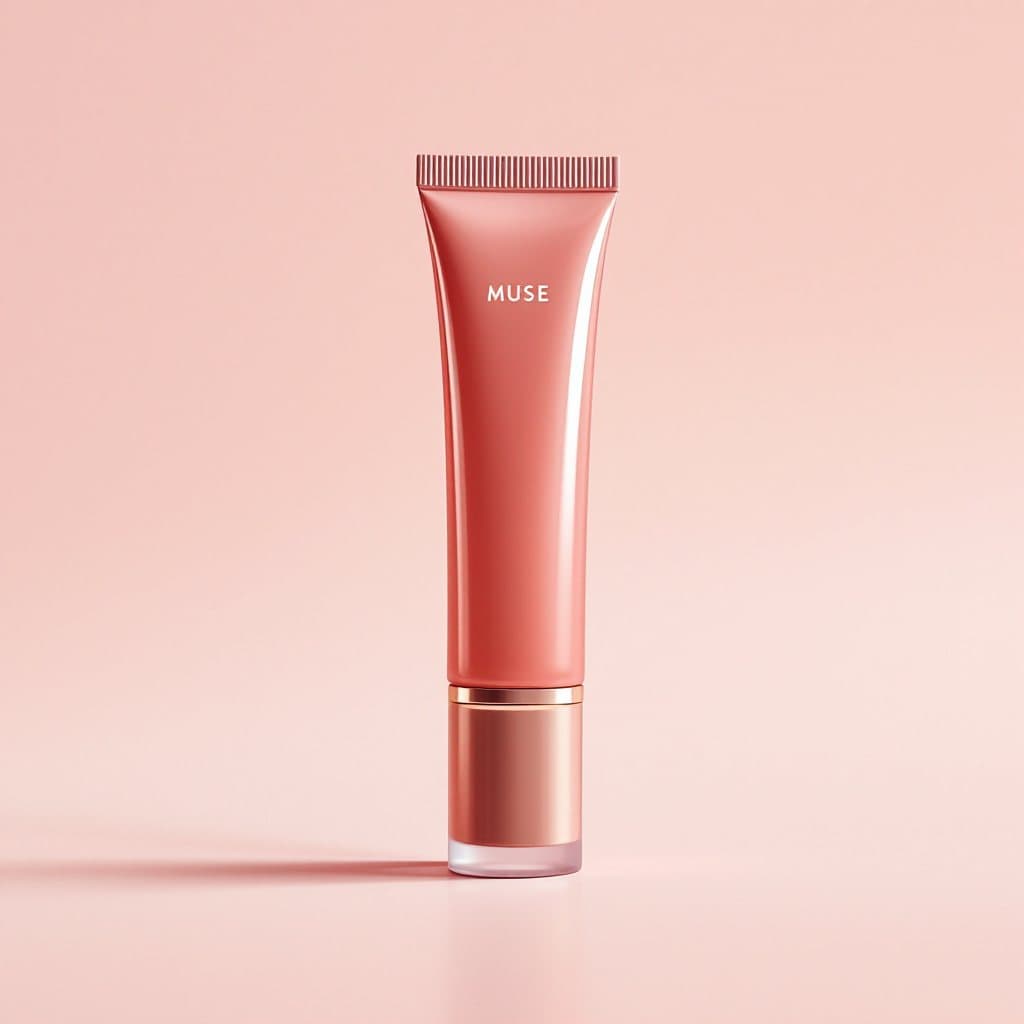
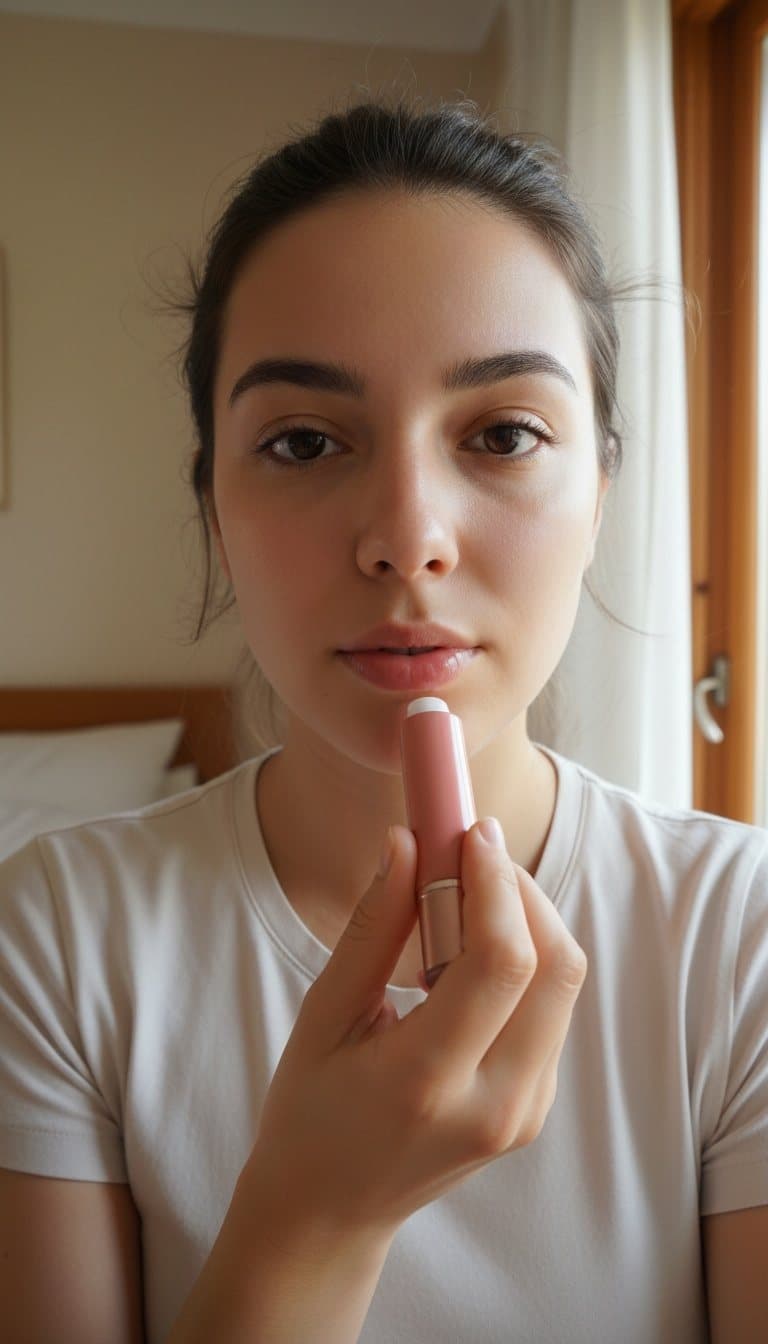
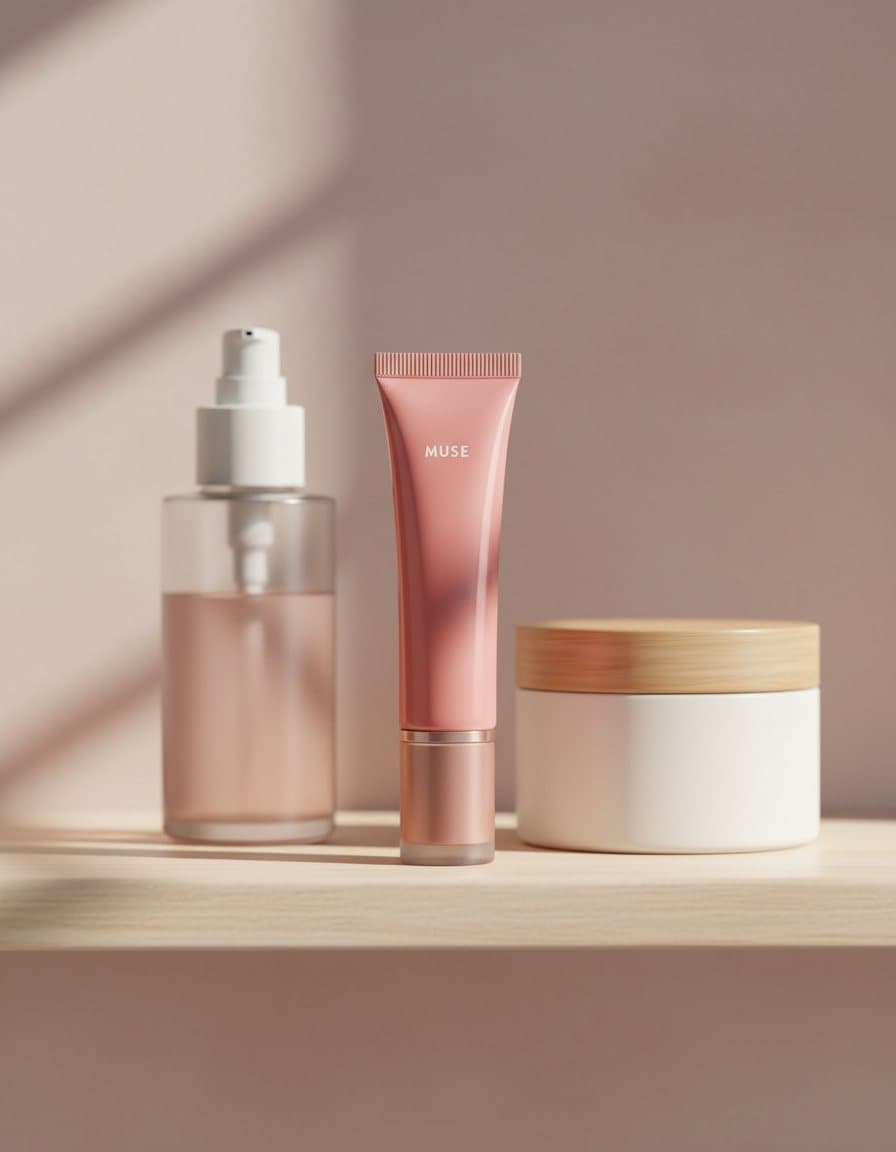
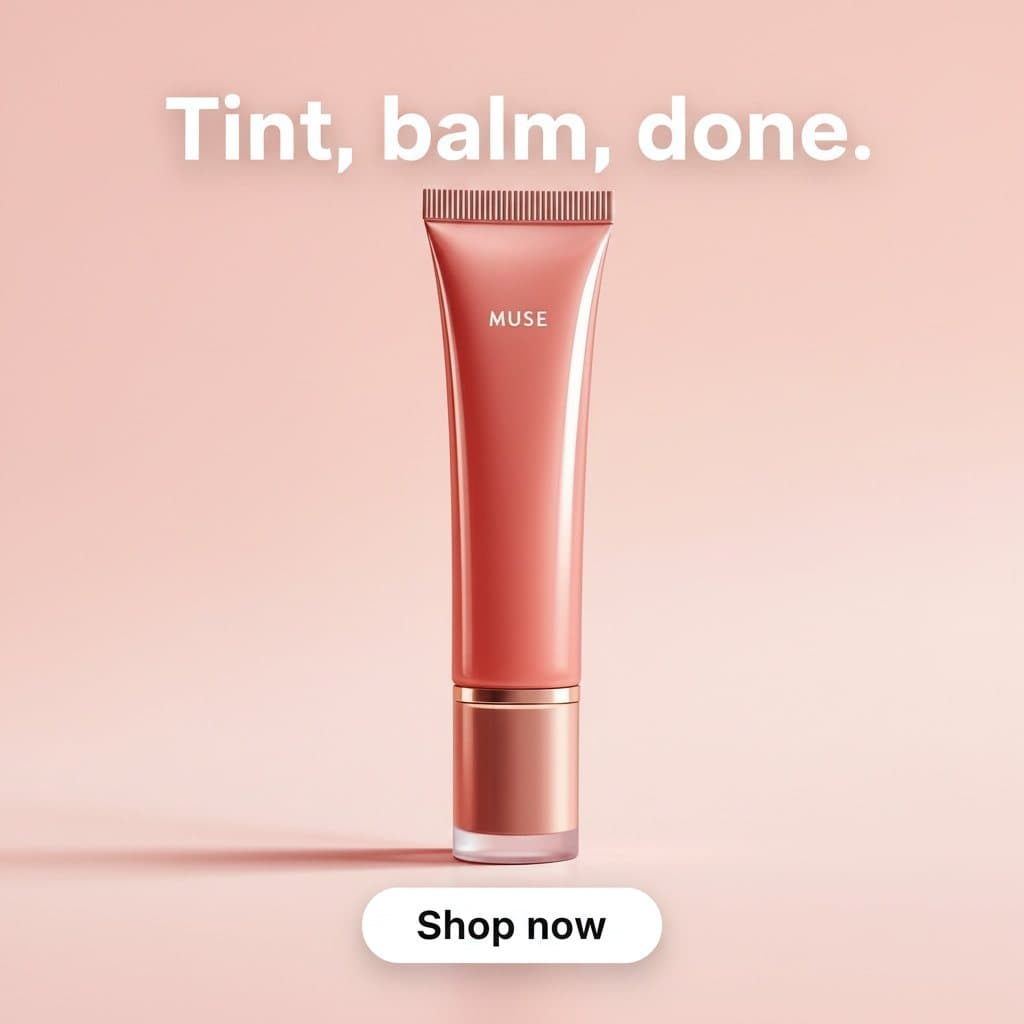
The product photo is an AI packshot of MUSE, a made-up tinted lip balm. The three ads are unedited advrt outputs. The UGC shot lost the MUSE wordmark; see below.
Colour cosmetics sell on shade, and shade is where generated images are least trustworthy. advrt keeps your packaging exact by editing your own product photo, then places it in scenes and on people. The tube is yours; the colour on a model's lips is the model's guess.
Below: the angles that fit lip, cheek and complexion products, where advrt's output needed a second look in our own test, the Meta rules that apply to makeup (fewer than skincare), and the spend advrt needs to judge a beauty ad against your account.
What tends to work for makeup on Meta
- Application shots carry colour cosmetics. A 9:16 “one swipe” selfie is the format to test first, but the shade shown is generated: compare it with your real swatch before it runs.
- Packaging hero ads are the most accurate thing advrt makes for beauty. The 1:1 above keeps the tube, cap and gradient exactly; put the one-line promise on it (“Tint, balm, done.”).
- Makeup is exempt from Meta's 18+ rule as a “non-permanent cosmetic and beauty product”. advrt's tests target 18+ anyway.
- Keep other brands out of the frame. “Dupe” ads that use another brand's name or logo run into Meta's IP standard.
- Budget reality: Lebesgue's Beauty and Health CAC is $34.29; at that level a four-ad test can spend up to $686 before every ad is judged.
Six angles for lip, cheek and complexion products
Mapped to advrt's seven formats. The hooks are our examples; advrt writes its own from your product page.
One-swipe demo
Format: UGC testimonial
Speed and ease are the selling points for a tinted balm or stick. A selfie-style shot shows the product at face scale.
- One swipe, no mirror.
- Lives in a jeans pocket, not a makeup bag.
Where it sits
Format: Comparison
Compare product types, not competitors. Placing a tinted balm between gloss and lipstick answers the shopper's real question without naming another brand.
- Sheer like a balm, colour like a tint.
- Balm, gloss or lipstick? This sits in the middle.
The shelf
Format: Lifestyle
A styled vanity shelf (the 4:5 above) sells the product as part of a routine and keeps the packaging large enough to recognise.
- The tube that never leaves the shelf.
- Morning routine, one step shorter.
Packaging hero
Format: Product hero
For beauty, the pack is part of the product. A clean 1:1 on a matching colour is the safest creative for accuracy.
- Tint, balm, done.
- Squeeze tube. No melting in a hot car.
Shade set
Format: Offer
Choosing a shade is the main barrier online. A set of minis removes it, if you sell one; advrt only writes offers that are in your input.
- Can't pick? Get all four minis.
- Free shade swap on your first order.
Wear-time reviews
Format: Social proof
Reviews that mention wear time or feel are the strongest beauty proof. Only usable when real reviews exist on the page.
- “Still there after lunch.” A real review, verbatim.
Before you generate anything
- Upload one photo per shade if shade is the sale. advrt preserves what's in the reference, so a photo of the pink tube can't produce the coral one.
- Add shade names and finish (sheer, satin, matte) to the product page. Hooks and comparison angles pull from it.
- Check every image with a person in it at full size: wordmark, pack shape and the colour on skin. Our MUSE selfie got the first two wrong.
- Write comparisons against a product type. advrt's comparison format doesn't need a competitor's name to work, and Meta's IP rules prefer it that way.
Meta's rules for makeup and colour cosmetics
Makeup gets lighter treatment than skincare, but a few rules still apply.
Checked on Meta's own pages in October 2026. advrt doesn't screen ads against these rules. Meta's ad review does: it relies mainly on automated tools, typically finishes within 24 hours, checks the landing page too, and can review ads again after they go live.
- No 18+ requirement for non-permanent makeup.
- Meta's Health and Wellness standard exempts “non-permanent cosmetic and beauty products such as creams, makeup, hair products” from its 18+ targeting rule. Permanent cosmetic procedures are not exempt.
- No statements of inferiority about appearance.
- Ads for cosmetic products can't contain “statements of inferiority about physical appearance” (same standard). “Finally, lips that aren't thin and pale” is the kind of line that fails.
- Don't address the viewer's appearance or age.
- The Personal Attributes standard rejects “Ready to upgrade your skin to look younger?” as an example. Describe the product's finish, not the reader's face.
- Keep dupes off other brands' names and logos.
- Meta's IP standard covers “products that copy the trademark (name or logo) and/or distinctive features of another company's products” made “to imitate a genuine product”.
- The shade shown must be the shade sold.
- “Product misrepresentation” is listed in Meta's fraud and scams standard. A generated lip colour that's two shades off is exactly that risk, which is why we flag shade checks throughout this page.
How much a beauty test spends before advrt calls it
We computed this table from the verdict rules in advrt's own code. advrt expects an ad that spent S to make S ÷ CPA purchases at your baseline and tests the real count against that (Poisson, one-sided, 10% significance). An ad becomes a loser once it has spent at least 1.5× CPA and its purchase count would happen less than 10% of the time at your baseline. Each ad stops at 5× CPA as inconclusive.
| CPA level | Loser call at 0 sales | Loser call at 1 sale | Fastest winner: 3 sales within | Spend cap per ad | Four-ad test, worst case |
|---|---|---|---|---|---|
| $34.29 Beauty and Health CAC, Lebesgue | $79 | $133 | $38 | $171 | $686 |
| $20.00 Example | $46 | $78 | $22 | $100 | $400 |
| $45.00 Example | $104 | $175 | $50 | $225 | $900 |
Lebesgue's figure covers Beauty and Health stores together (published 9 March 2026). The $20 and $45 rows are round examples for a single lip product and a bundle. Multipliers: loser at 2.30× CPA with no sales or 3.89× with one; winner with 3 sales by 1.10× CPA. Assumes each ad's daily budget is under 5/3 of CPA; above that, the cap becomes three days of budget.
What the table means
The written rule for a winner is at least 3 purchases and a CPA at least 15% better than your account. The statistics set a higher bar: to win by the spend cap, an ad needs 9 sales on 5× CPA of spend, a CPA about 44% below your baseline. An ad that's 20% better will usually end inconclusive. That's deliberate: small budgets can't separate small differences, and advrt would rather say so than guess.
Purchase verdicts need at least 10 purchases in your account's last 30 days. Without them, advrt judges click-through rate instead: 1,000+ impressions and a CTR at least 20% above or below your baseline.
What we saw making the ads above
Look closely at the MUSE UGC shot. The lifestyle and feed ads kept the squeeze tube, the MUSE wordmark and the copper base. In the selfie, the wordmark is gone and the tube came out shorter, closer to a lipstick. It's unedited, so we left it up; for a real launch we'd regenerate it.
The lip colour on the model is generated too. advrt's preservation prompt protects the product, not what the product looks like once applied. For any tinted product, treat on-skin images as mood shots and check them against a real swatch.
Method: one AI packshot per product (Flux Pro 1.1, 1024×1024), then advrt's image path (Nano Banana edit) for each ad, every prompt starting with advrt's product-preservation instruction: same shape, colours, materials, label, logo and packaging text.
advrt, UGC creators, a photoshoot or a generic AI tool for beauty
| Criterion | advrt | UGC creators | Product photoshoot | Generic AI ad generator |
|---|---|---|---|---|
| Cost | Free plan: 5 generations a month. Basic $19.99/mo adds live Meta tests; Pro $49/mo. Ad spend is paid to Meta separately. | From $99 per video with usage rights at Billo; from $89 at soona | soona: $39 per photo, $149 studio pass, full-body model $159/hour, hair and makeup $299 per model | AdCreative.ai from $39/mo for 20 credits; Creatify from $15/mo (monthly billing) |
| What you get | Angles, hooks, Meta copy and image ads in four sizes, with your real packaging | Real application on real skin, which is the only true swatch | Exact packaging and, with a model booked, real on-lip colour | Templates and AI scenes from your uploads |
| Product accuracy | Packaging edited from your photo; shade on skin is generated | Exact | Exact | Varies by tool |
| Live test on Meta | Yes, on Basic: one ad set per creative, equal budgets, verdicts against your own account | No. You run and judge it | No. You run and judge it | Varies by tool; check whether it judges results |
| Main tradeoff | Generated shades can drift; one of our three shots lost the logo | Per-video cost adds up across a shade range | A model day with hair and makeup costs more than most test budgets | No judging against your own account's results |
Third-party prices from each company's own pricing page, checked October 2026. Prices change; check before you buy. advrt prices come from its live plan settings.
Questions beauty brands ask
- Do makeup ads on Facebook need 18+ targeting?
- No. Meta's Health and Wellness standard exempts non-permanent cosmetic and beauty products such as makeup and creams from its 18+ rule. advrt's live tests target 18+ by default regardless.
- Can AI show my lipstick shade accurately?
- Not reliably. advrt preserves the packaging from your photo, but colour on lips or skin is generated. In our MUSE test the packaging was right in two of three ads and the on-lip colour was the model's own choice. Check every on-skin image against a real swatch.
- What makes a beauty ad convert?
- We can't promise a pattern; that's what testing is for. Beauty brands most often test an application shot against a packaging hero and a shade-set offer. advrt runs each in its own ad set and judges them against your account's last 30 days.
- Can I run a dupe ad that names the original brand?
- Meta's third-party IP standard covers products that copy another company's trademark or distinctive features to imitate a genuine product. Compare against a product type (gloss, lipstick) instead of a named brand.
- What CPA should a beauty brand expect on Meta?
- Lebesgue's Facebook benchmark for Beauty and Health stores is a $34.29 CAC (March 2026). Order value moves it a lot: a $14 lip balm and a $90 palette are different businesses.
- Does advrt make video for makeup?
- Yes. It can animate a product still into an 8-second Veo 3 Fast clip, or generate video from text with Veo 3, Kling 2.1 Master or Luma. Expect re-rolls: in our tests about one in three image-to-video renders needed one.
advrt for your kind of team
DTC & Shopify
Founders and growth leads running Shopify brands on Meta.
Creators & UGC
UGC creators and small studios making ads for brands.

Solo founders
One-person stores and side projects selling a physical product.
Other industries
Pricing
- Free $0/mo. See your own product in real ads. No card.
- Basic $19.99/mo. Launch tests on Meta and keep the winners.
- Pro $49/mo. For brands and agencies testing every week.
Sources
- Meta: Health and Wellness ad standard (updated 22 Jul 2026)
- Meta: Privacy Violations and Personal Attributes
- Meta: Third-Party Intellectual Property Infringement
- Meta: Introduction to the Advertising Standards
- Meta: Fraud, Scams and Deceptive Practices
- Lebesgue: Facebook benchmarks by industry (9 Mar 2026)
- Billo: how Billo pricing works (9 Oct 2026)
- soona pricing
- AdCreative.ai pricing
- Creatify pricing
Make your first beauty ad from a product link.
Paste your product page and see ads with your real product in them. Free plan: 5 ad generations a month, no card.