Clothing ads from the product photos you already have
advrt makes Meta clothing ads from your product page, placing your real garment on generated models and in flat lays. Fit, drape and text on fabric are generated, so check them.
Free plan: 5 ad generations a month, no card. Nothing spends until you confirm a test.
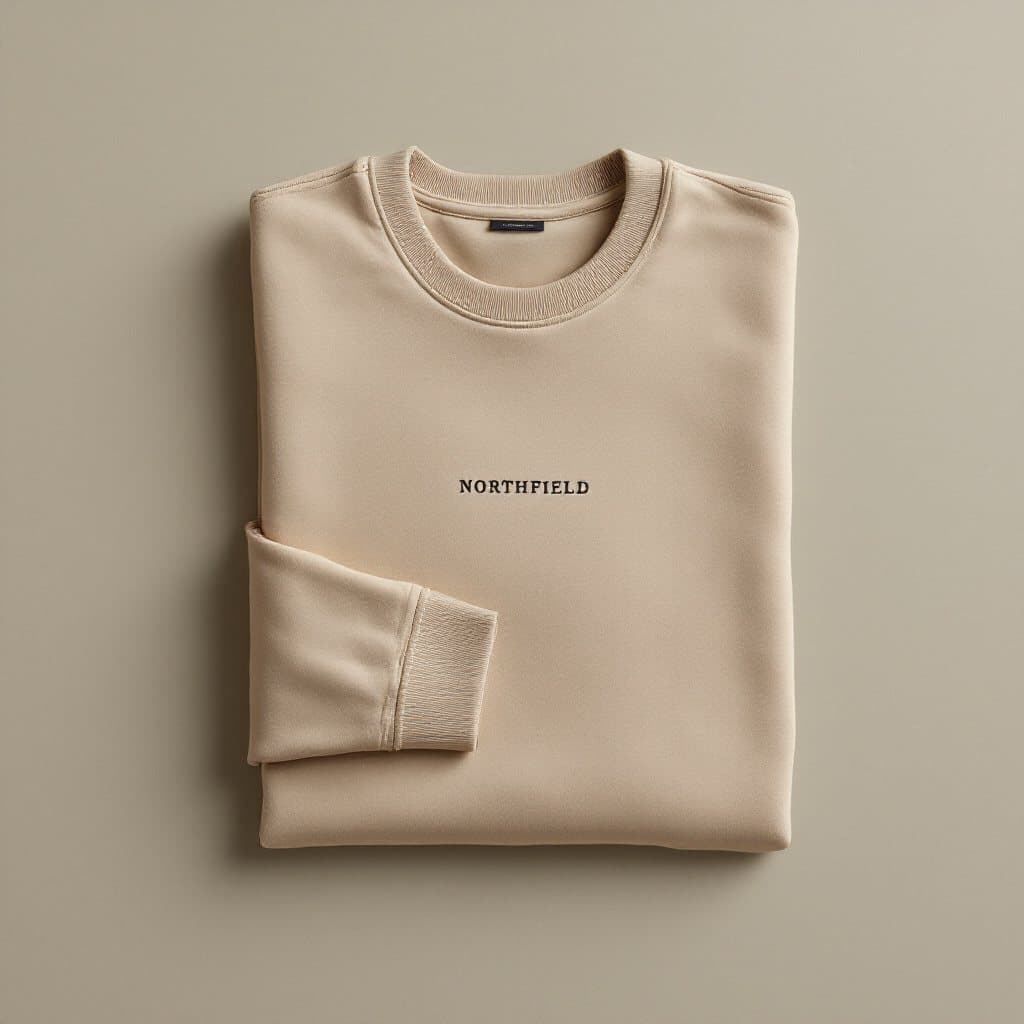
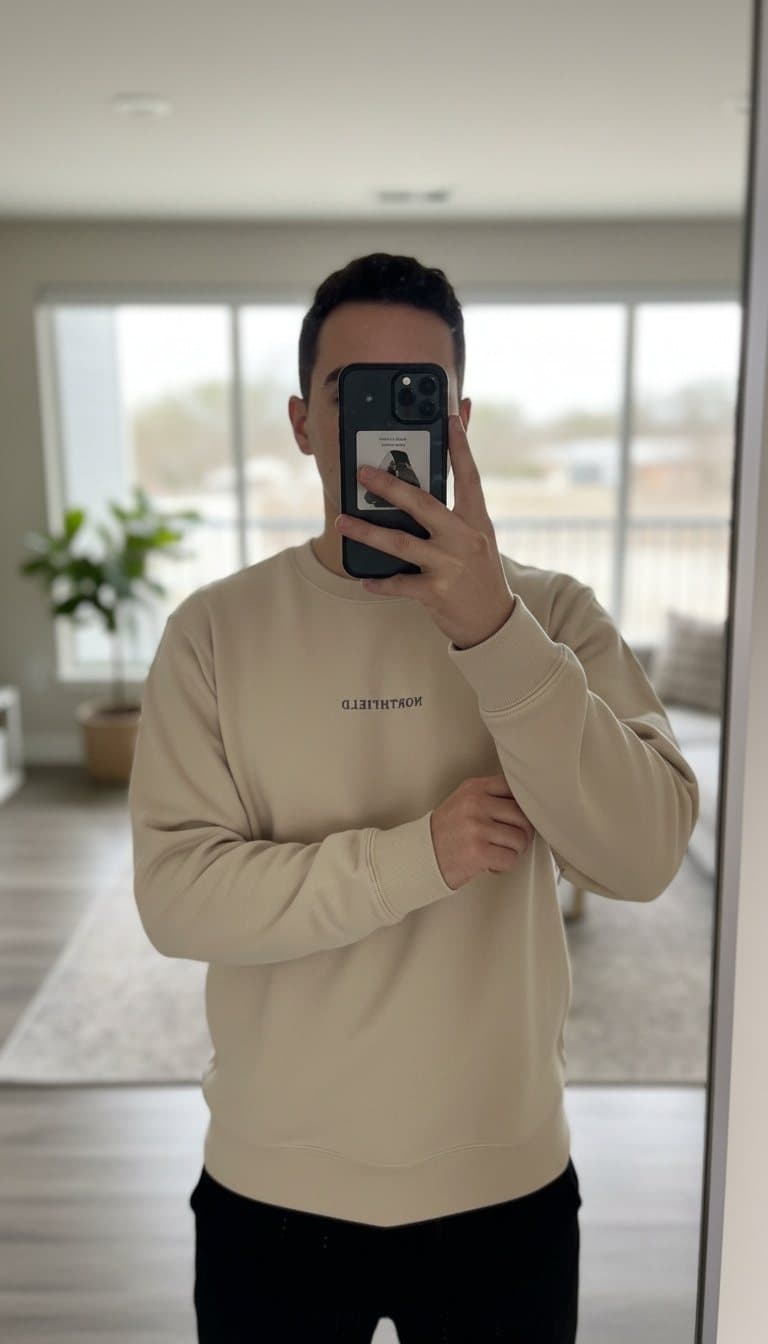

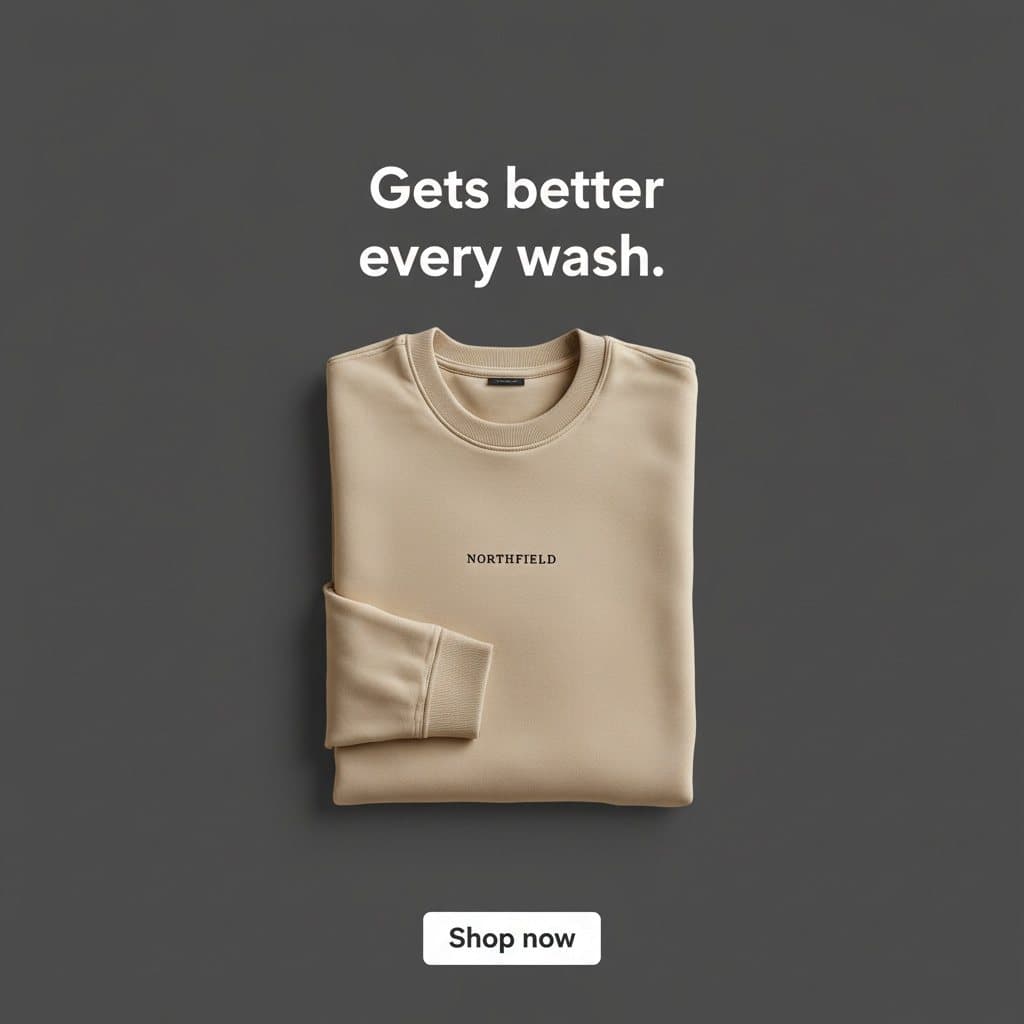
The product photo is an AI packshot of NORTHFIELD, a made-up brand. The three ads are unedited advrt outputs.
Clothing ads have to answer “how does it look on a person?”, and that's the hardest thing for a generated image to get right. advrt starts from your own garment photo and keeps colour, cut and branding as close to it as the edit model can, then puts it in scenes and on generated models. Flat lays come out closest to the source; on-body shots need the most checking.
This page covers the angles that fit basics and everyday apparel, where our NORTHFIELD sweatshirt test went wrong (a mirror selfie flipped some letters of the wordmark), Meta's rules on revealing clothing, and what a test costs at apparel-level CPAs.
What tends to work for clothing on Meta
- Flat lays are the most accurate format advrt makes for apparel. The 1:1 above keeps the rib, cuffs and wordmark of the source photo.
- On-body lifestyle shots sell, but fit is generated. The autumn-lake ad reads well; whether your sweatshirt actually drapes like that is unknown.
- Mirror selfies read as UGC, and garble text. Our NORTHFIELD selfie came back with some letters of the wordmark flipped; the tote's came back as “SALAA”.
- Revealing clothing and body-part crops need 18+ targeting under Meta's adult content standard. advrt's tests are 18+ by default.
- Budget reality: Lebesgue's Clothing and Fashion CAC is $28.08, so a zero-sale loser can be called after about $65 per ad.
Six angles for everyday apparel
Mapped to advrt's seven formats. Example hooks we wrote; advrt writes its own from your product page.
The wash test
Format: Product hero
Durability is the main objection for basics. A flat lay with one line of copy carries it, and flat lays are where generated images stay most faithful.
- Gets better every wash.
- Heavyweight cotton. Still square after 50 washes.
Where you'd wear it
Format: Lifestyle
A place and a season sell basics better than the garment alone. Keep the garment large in frame so it's recognisable.
- Cold mornings, sorted.
- The one you reach for in October.
Fit check
Format: UGC testimonial
Mirror selfies are the native format for clothing on Stories and Reels. Check any text on the garment, which mirrors and garbles easily.
- Fit check: true to size, slightly boxy.
- Size M on a 6 ft frame.
Fabric weight
Format: Comparison
Compare fabric weight or construction against a category (“fast-fashion sweatshirts”), using numbers from your own spec sheet.
- 400 gsm vs. the 280 gsm sweatshirt that pills by March.
Size reviews
Format: Social proof
Fit doubt is the biggest reason apparel doesn't sell online. Real reviews about sizing answer it. Only when reviews are on the page.
- “Runs true to size.” Straight from our reviews.
Bundle
Format: Offer
Basics sell in multiples. A two-pack or colour bundle raises order value, if you sell one.
- Two colours, one price.
- Free exchanges on size.
Before you generate anything
- Upload a flat lay or ghost-mannequin photo with the whole garment visible. An edit can't add a back print it has never seen.
- Use one colourway per photo. To test colours, import or photograph each one separately.
- Skip mirror selfies for garments with text or prints, or check every letter. Ours flipped.
- Put fabric weight, composition and fit notes on the product page, so comparison and fit-check angles have real facts to use.
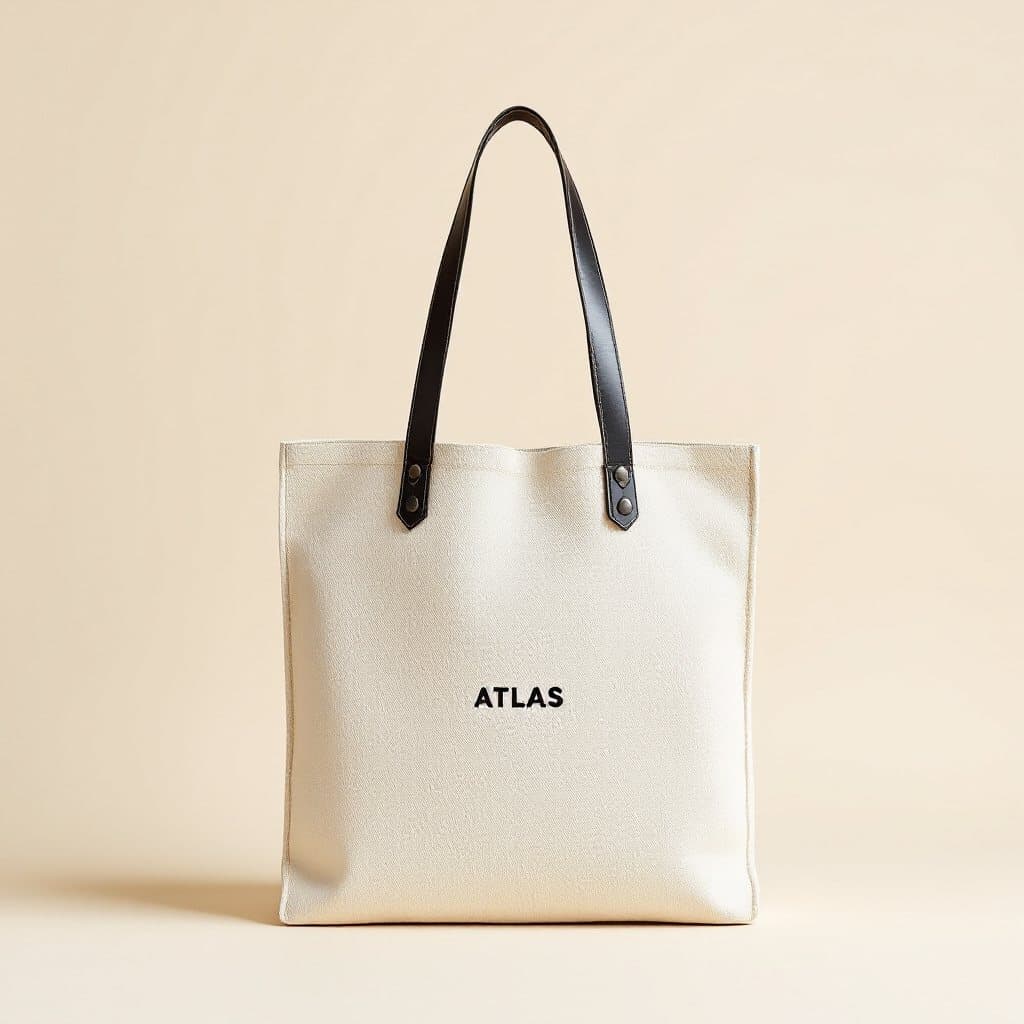
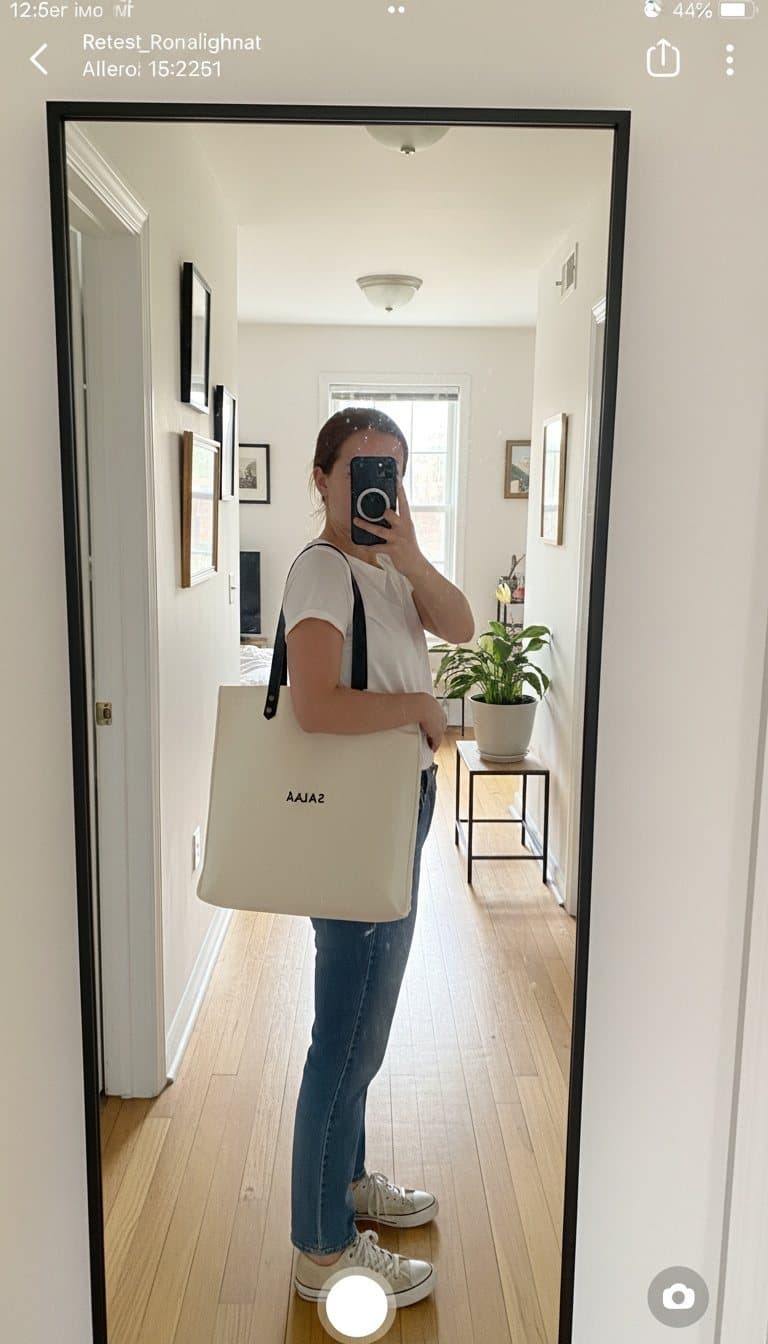
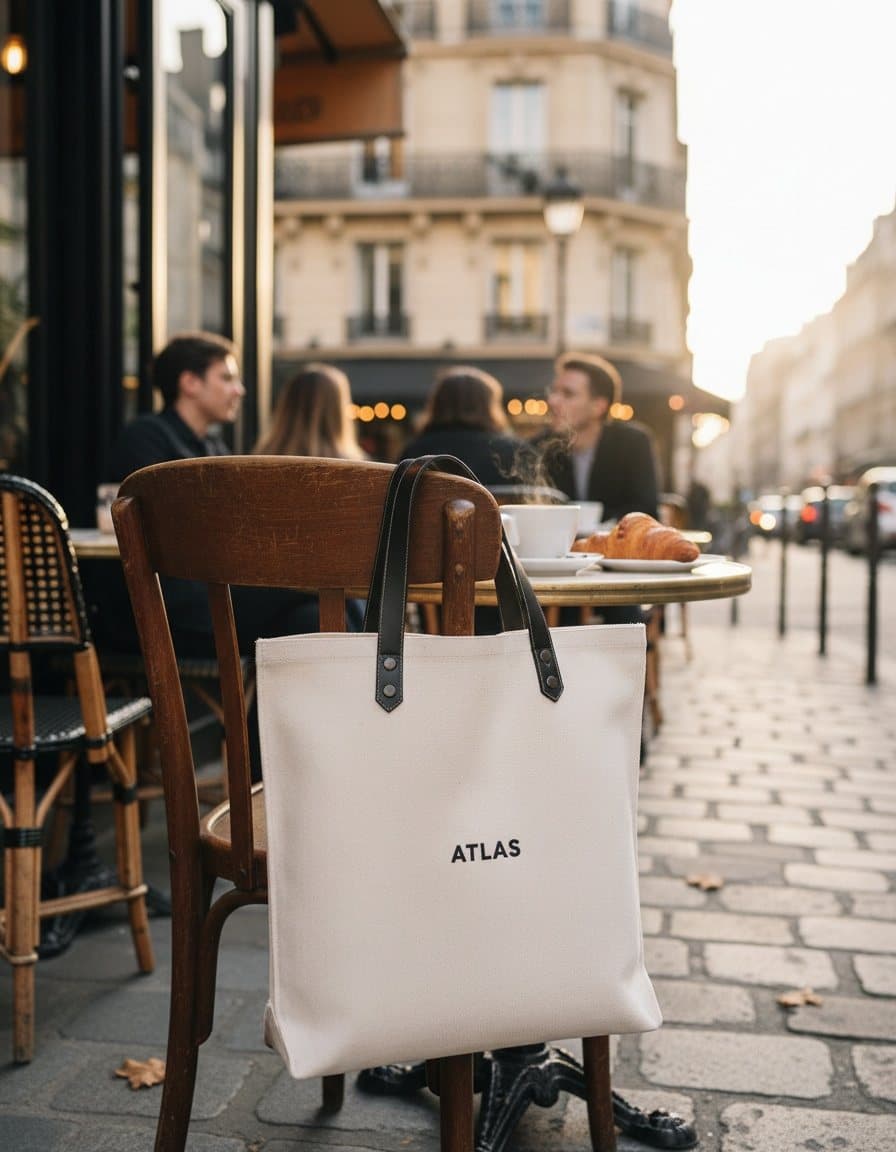
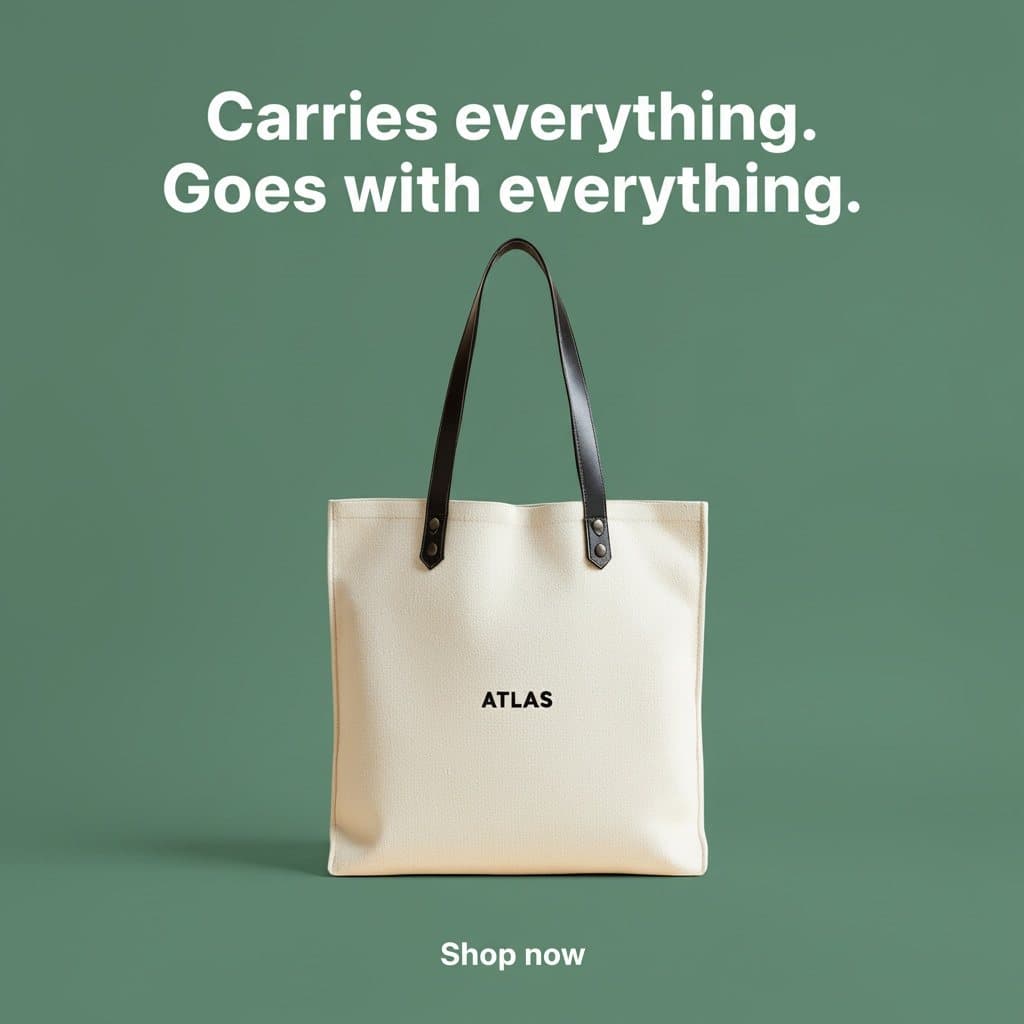
A canvas tote from the same test. Its mirror selfie reversed and garbled the ATLAS logo. Unedited advrt outputs.
Meta's rules for apparel creative
Apparel has no category-specific Meta standard. These general ones apply most often.
Checked on Meta's own pages in October 2026. advrt doesn't screen ads against these rules. Meta's ad review does: it relies mainly on automated tools, typically finishes within 24 hours, checks the landing page too, and can review ads again after they go live.
- Revealing clothing and body-part focus need 18+ targeting.
- Meta's Adult Nudity and Sexual Activity ad standard requires 18+ targeting for images “focused on individual body parts such as groin, buttock or female breast(s)” or “depicting people in sexually suggestive poses, revealing clothing”. Nudity is banned outright, including when covered only by a digital overlay. This matters for swimwear, lingerie and activewear crops.
- No lookalikes of other brands.
- The IP standard covers products that copy “the trademark (name or logo) and/or distinctive features of another company's products”. Keep other brands' logos out of generated scenes, including on props.
- Colour and fit must match what ships.
- Meta's fraud and scams standard lists “product misrepresentation”. A generated model can make a boxy fit look tailored; check on-body images against your real garment before they run.
How much a clothing test spends before advrt calls it
We computed this table from the verdict rules in advrt's own code. advrt expects an ad that spent S to make S ÷ CPA purchases at your baseline and tests the real count against that (Poisson, one-sided, 10% significance). An ad becomes a loser once it has spent at least 1.5× CPA and its purchase count would happen less than 10% of the time at your baseline. Each ad stops at 5× CPA as inconclusive.
| CPA level | Loser call at 0 sales | Loser call at 1 sale | Fastest winner: 3 sales within | Spend cap per ad | Four-ad test, worst case |
|---|---|---|---|---|---|
| $28.08 Clothing and Fashion CAC, Lebesgue | $65 | $109 | $31 | $140 | $562 |
| $40.00 Example | $92 | $156 | $44 | $200 | $800 |
| $70.00 Example | $161 | $272 | $77 | $350 | $1,400 |
Lebesgue's figure is Facebook CAC for Clothing and Fashion stores (published 9 March 2026). $40 and $70 are round examples for premium basics and outerwear. Multipliers: loser at 2.30× CPA with no sales or 3.89× with one; winner with 3 sales by 1.10× CPA. Assumes each ad's daily budget is under 5/3 of CPA; above that, the cap becomes three days of budget.
What the table means
The written rule for a winner is at least 3 purchases and a CPA at least 15% better than your account. The statistics set a higher bar: to win by the spend cap, an ad needs 9 sales on 5× CPA of spend, a CPA about 44% below your baseline. An ad that's 20% better will usually end inconclusive. That's deliberate: small budgets can't separate small differences, and advrt would rather say so than guess.
Purchase verdicts need at least 10 purchases in your account's last 30 days. Without them, advrt judges click-through rate instead: 1,000+ impressions and a CTR at least 20% above or below your baseline.
What we saw making the ads above
Zoom into the NORTHFIELD mirror selfie. The wordmark came back partly reversed: some letters flipped as a mirror would flip them, others didn't. A real mirror reverses all of it. Nobody scrolling will read it, but anyone who stops will.
The ATLAS tote's mirror selfie was worse: the logo came back reversed and garbled as “SALAA”, and the model drew a fake phone-camera interface on top with nonsense text. For apparel with prominent branding, prefer lifestyle and flat-lay formats, or ask for a non-mirror shot.
Method: one AI packshot per product (Flux Pro 1.1, 1024×1024), then advrt's image path (Nano Banana edit) for each ad, every prompt starting with advrt's product-preservation instruction: same shape, colours, materials, label, logo and packaging text.
advrt, UGC creators, a model shoot or a generic AI tool for clothing
| Criterion | advrt | UGC creators | Product photoshoot | Generic AI ad generator |
|---|---|---|---|---|
| Cost | Free plan: 5 generations a month. Basic $19.99/mo adds live Meta tests; Pro $49/mo. Ad spend is paid to Meta separately. | From $99 per video with usage rights at Billo; from $89 at soona | Squareshot: full-body model images use 4 credits at $45 to $60 a credit (about $180 to $240 per image, our arithmetic), ghost mannequin 1.5 credits | AdCreative.ai from $39/mo for 20 credits; Creatify from $15/mo (monthly billing) |
| What you get | Angles, Meta copy, flat lays and on-model scenes from your garment photo, in four sizes | Real people wearing your real garment, with real fit | Exact colour and fit on a real model, ready for product pages too | Templates and AI scenes; some tools offer virtual try-on |
| Product accuracy | Garment edited from your photo; fit and drape are generated | Exact | Exact, including colour-matched retouching | Varies by tool |
| Live test on Meta | Yes, on Basic: one ad set per creative, equal budgets, verdicts against your own account | No. You run and judge it | No. You run and judge it | Varies by tool; check whether it judges results |
| Main tradeoff | Text on fabric can garble in mirror shots | One creator per body type; size range costs more | Highest cost per image, and per-colour reshoots | No judging against your own account's results |
Third-party prices from each company's own pricing page, checked October 2026. Prices change; check before you buy. advrt prices come from its live plan settings.
Questions clothing brands ask
- What makes a clothing ad convert on Meta?
- Usually a clear view of the garment on a body, a fit answer, and a reason to buy now. Which works for your brand is a testing question; advrt runs each creative in its own ad set and judges it against your account's last 30 days.
- Can AI put my clothes on a model accurately?
- It keeps colour and branding reasonably well when it starts from your photo, but fit and drape are generated. In our test, text on the garment garbled in mirror selfies. Flat lays were the most accurate.
- Do swimwear and lingerie ads need special targeting on Facebook?
- Yes. Meta's adult content ad standard requires 18+ targeting for images focused on individual body parts or showing revealing clothing, and bans nudity outright.
- What CPA do clothing brands see on Facebook?
- Lebesgue reports a $28.08 Facebook CAC for Clothing and Fashion stores (March 2026). Your own baseline matters more, and that's what advrt judges against.
- Should clothing ads show the price?
- It depends on whether price is an advantage. advrt never invents prices or discounts; it uses the ones on your product page, and only writes an offer angle when there's an offer.
- Can advrt import my whole Shopify catalogue?
- Up to 250 products per run with an Admin API token. It's a one-off import, not a live sync, so new products need another import or a URL paste.
advrt for your kind of team

DTC & Shopify
Founders and growth leads running Shopify brands on Meta.

Scaling ecom
Growth leads at ecommerce brands with a lean in-house creative team.

Amazon & catalog
Amazon, Walmart and Etsy sellers sending Meta and TikTok traffic to their listings.
Further reading
Other industries
Pricing
- Free $0/mo. See your own product in real ads. No card.
- Basic $19.99/mo. Launch tests on Meta and keep the winners.
- Pro $49/mo. For brands and agencies testing every week.
Sources
- Meta: Adult Nudity and Sexual Activity (ads)
- Meta: Third-Party Intellectual Property Infringement
- Meta: Introduction to the Advertising Standards
- Meta: Fraud, Scams and Deceptive Practices
- Lebesgue: Facebook benchmarks by industry (9 Mar 2026)
- Billo: how Billo pricing works (9 Oct 2026)
- soona pricing
- AdCreative.ai pricing
- Creatify pricing
- Squareshot pricing
Make your first clothing ad from a product link.
Paste your product page and see ads with your real product in them. Free plan: 5 ad generations a month, no card.