Shoe ads built from your own product page
advrt makes Meta sneaker and footwear ads from your product photo, keeping the real colourway and sole. Comfort copy can trip Meta's personal-attribute rule; describe the shoe.
Free plan: 5 ad generations a month, no card. Nothing spends until you confirm a test.
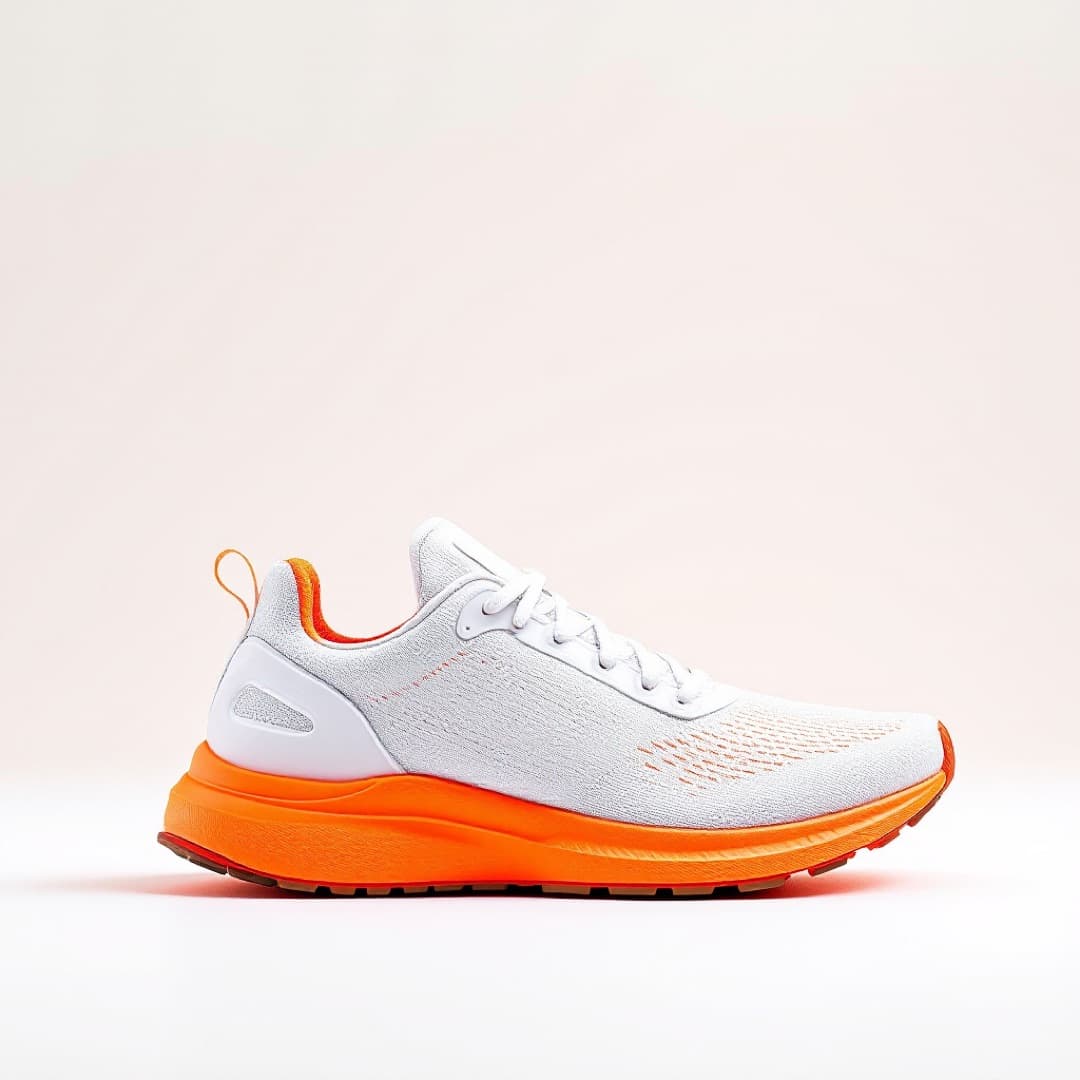
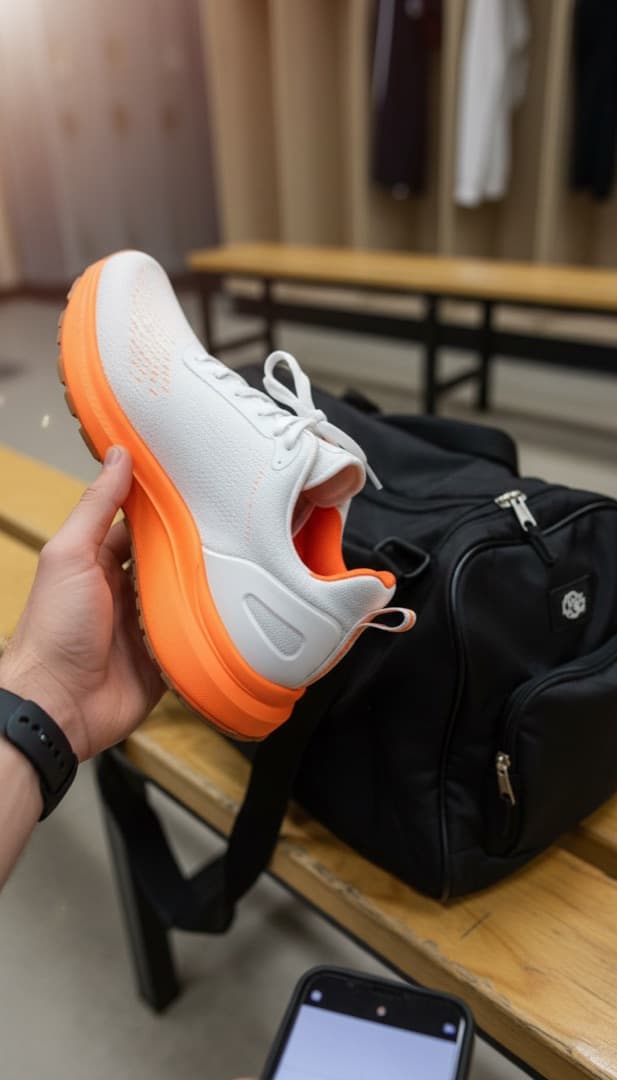
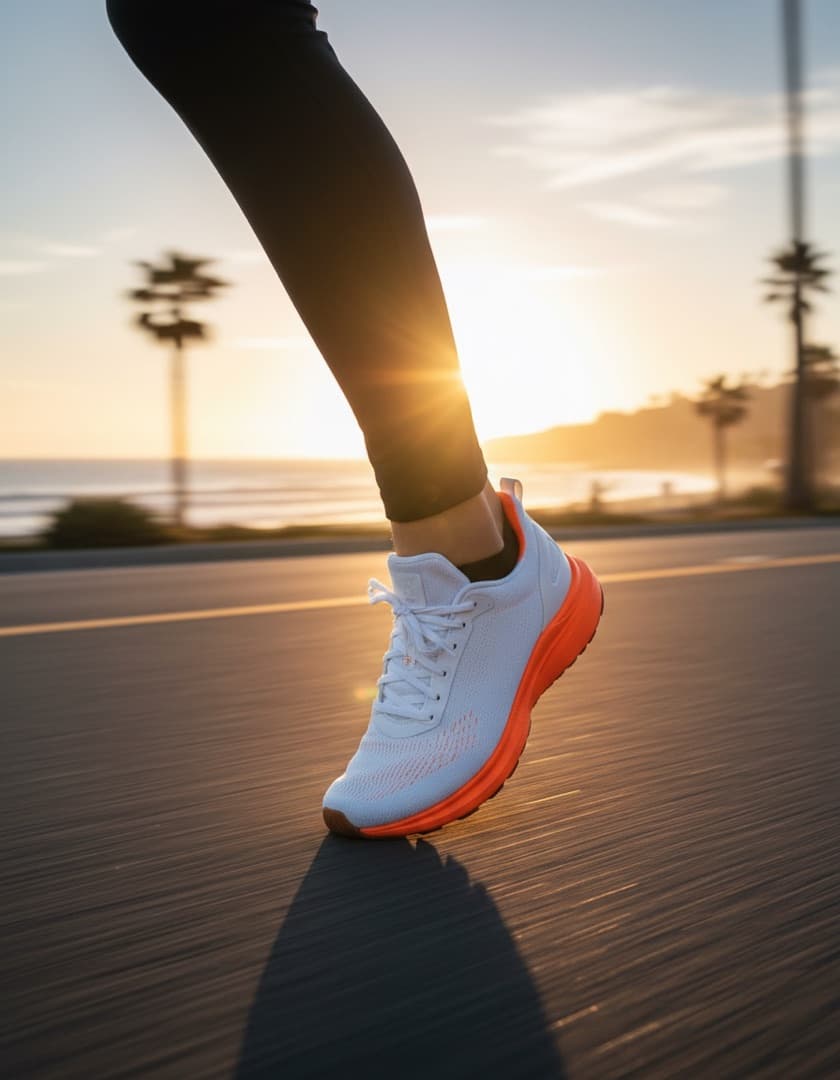

The product photo is an AI packshot of a made-up running shoe. The three ads are unedited advrt outputs.
Footwear buyers zoom in. They want the sole, the colourway and the shape of the heel counter before they think about the scene. advrt starts from your own shoe photo, keeps those details, and places the shoe in motion, on a bench, or on a bold colour.
Below: angles that fit running and lifestyle sneakers, how to write comfort copy without breaking Meta's personal-attribute rule, and what a test costs. We couldn't find a public footwear-only Meta CPA benchmark, so the spend table uses labelled example CPAs.
What tends to work for shoes on Meta
- Motion sells running shoes. The mid-stride road shot above is a still; advrt can animate a still into an 8-second Veo 3 Fast clip, with re-rolls to expect.
- Profile product heroes keep what buyers zoom in on: sole colour, upper texture, heel shape. The floating orange 1:1 above is the most faithful format.
- Gym-bag and locker-room UGC shows the shoe at hand scale, which reads as real for performance footwear.
- Comfort copy must describe the shoe, not the foot. “Sore feet after 5k?” implies a health condition; “cushioning for the last 5k” doesn't.
- No public footwear CPA benchmark. We found none from a primary source, so the table below uses round example CPAs.
Six angles for sneakers and running shoes
Mapped to advrt's seven formats. Example hooks we wrote; advrt writes its own from your product page.
Built for the distance
Format: Product hero
A floating profile on a bold colour shows the sole and shape clearly, and one line of copy sets the use case.
- Built for the long run.
- 8 mm drop. 240 grams. Nothing else to say.
The run
Format: Lifestyle
Golden-hour road shots sell the feeling of the run. Keep the shoe in focus; motion blur on the product hides the colourway.
- Sunset miles.
- Same route, new pair.
Straight from the bag
Format: UGC testimonial
A hand holding the shoe over a gym bag is a believable, low-production frame. It also shows the shoe at real scale.
- What's in my gym bag this month.
- Swapped my old pair for these.
The last 5k
Format: Problem and solution
Frame the problem as what the shoe is for, not what's wrong with the runner's body.
- Cushioning for the last 5k, not just the first.
- Grip for wet Sunday long runs.
Spec versus spec
Format: Comparison
Runners compare stack height, drop and weight. A spec contrast against a generic “typical trainer” is honest if your numbers are real.
- 40 grams lighter than the trainer you're in now.
Run trial
Format: Offer
Fit risk is the main barrier for shoes bought online. A trial or free exchange removes it, if you offer one.
- Run 30 days. Return them if they're wrong.
- Free size exchanges.
Before you generate anything
- Upload a clean side profile. It carries the sole, colourway and heel shape that edits preserve best.
- Use one colourway per product photo. A white-and-orange photo can't produce the black pair.
- Put stack height, drop and weight on the product page if you want spec angles.
- For video, keep the shoe still and let the camera or background move. Rotation is where our logos broke.
Meta's rules for sneakers and running shoes
There's no footwear-specific Meta standard. These are the general rules shoe ads run into.
Checked on Meta's own pages in October 2026. advrt doesn't screen ads against these rules. Meta's ad review does: it relies mainly on automated tools, typically finishes within 24 hours, checks the landing page too, and can review ads again after they go live.
- Comfort copy can become a personal-attribute claim.
- Meta's Personal Attributes standard bans ads that “assert or imply” a person's physical health. Its rejected examples include “Do you have diabetes?”. “Plantar fasciitis again?” follows the same pattern; “Designed with arch support” doesn't.
- No copies of other brands' silhouettes.
- The IP standard covers products copying “distinctive features of another company's products” to imitate a genuine one. Iconic sneaker silhouettes count.
- The colourway in the ad is the colourway that ships.
- “Product misrepresentation” is in Meta's fraud and scams standard. Check generated motion shots for sole and upper colour drift.
How much a shoe test spends before advrt calls it
We computed this table from the verdict rules in advrt's own code. advrt expects an ad that spent S to make S ÷ CPA purchases at your baseline and tests the real count against that (Poisson, one-sided, 10% significance). An ad becomes a loser once it has spent at least 1.5× CPA and its purchase count would happen less than 10% of the time at your baseline. Each ad stops at 5× CPA as inconclusive.
| CPA level | Loser call at 0 sales | Loser call at 1 sale | Fastest winner: 3 sales within | Spend cap per ad | Four-ad test, worst case |
|---|---|---|---|---|---|
| $30.00 Example | $69 | $117 | $33 | $150 | $600 |
| $50.00 Example | $115 | $194 | $55 | $250 | $1,000 |
| $80.00 Example | $184 | $311 | $88 | $400 | $1,600 |
We found no public, primary-source Meta CPA benchmark for footwear as of October 2026, so all three rows are round examples. Use your own ad account's CPA: that's what advrt judges against. Multipliers: loser at 2.30× CPA with no sales or 3.89× with one; winner with 3 sales by 1.10× CPA. Assumes each ad's daily budget is under 5/3 of CPA; above that, the cap becomes three days of budget.
What the table means
The written rule for a winner is at least 3 purchases and a CPA at least 15% better than your account. The statistics set a higher bar: to win by the spend cap, an ad needs 9 sales on 5× CPA of spend, a CPA about 44% below your baseline. An ad that's 20% better will usually end inconclusive. That's deliberate: small budgets can't separate small differences, and advrt would rather say so than guess.
Purchase verdicts need at least 10 purchases in your account's last 30 days. Without them, advrt judges click-through rate instead: 1,000+ impressions and a CTR at least 20% above or below your baseline.
What we saw making the ads above
The images above are unedited. The white knit upper, orange sole and heel pull tab match the source photo across all three, including the motion-blurred road shot, where the shoe stays sharp while the road blurs.
We didn't render a shoe video for this showcase. From the three product videos we did make, the lesson that carries over is that logos and shapes break when the product rotates. A shoe turning on a plinth is exactly that motion, so ask for a steady product and let the camera or background move instead.
Method: one AI packshot per product (Flux Pro 1.1, 1024×1024), then advrt's image path (Nano Banana edit) for each ad, every prompt starting with advrt's product-preservation instruction: same shape, colours, materials, label, logo and packaging text.
advrt, UGC creators, a shoe shoot or a generic AI tool
| Criterion | advrt | UGC creators | Product photoshoot | Generic AI ad generator |
|---|---|---|---|---|
| Cost | Free plan: 5 generations a month. Basic $19.99/mo adds live Meta tests; Pro $49/mo. Ad spend is paid to Meta separately. | From $99 per video with usage rights at Billo; from $89 at soona | soona: $39 per photo, $149 studio pass, foot model $99/hour; Squareshot: shoes are a standard 1-credit image | AdCreative.ai from $39/mo for 20 credits; Creatify from $15/mo (monthly billing) |
| What you get | Angles, Meta copy and image ads with your real shoe in motion and on colour, in four sizes | Real people running and walking in your shoe | Exact profiles and detail shots, and on-foot shots with a foot model | Templates and AI scenes from your uploads |
| Product accuracy | Shoe edited from your photo; on-foot fit is generated | Exact | Exact | Varies by tool |
| Live test on Meta | Yes, on Basic: one ad set per creative, equal budgets, verdicts against your own account | No. You run and judge it | No. You run and judge it | Varies by tool; check whether it judges results |
| Main tradeoff | No real gait or flex; motion is generated | Shoes have to ship to each creator, and come back if you want them | On-foot shots need a model booking on top of the studio | No judging against your own account's results |
Third-party prices from each company's own pricing page, checked October 2026. Prices change; check before you buy. advrt prices come from its live plan settings.
Questions footwear brands ask
- What makes a shoe ad high-converting?
- We can't give you a universal answer, and pages that do are guessing. Shoe brands usually test motion against a clean profile and a trial offer. advrt runs each in its own ad set and judges it against your account's last 30 days.
- Video or image for shoe ads?
- Both are worth testing. advrt makes stills in four sizes and can animate a still into an 8-second clip. Expect about one in three image-to-video renders to need a re-roll, mostly when the product rotates.
- Can I talk about foot pain in a shoe ad?
- Not about the viewer's. Meta's Personal Attributes standard bans copy that asserts or implies a person's health condition. Describe the shoe's features (arch support, cushioning) instead.
- What CPA should a footwear brand expect on Meta?
- We couldn't find a public primary-source footwear benchmark. Lebesgue's Clothing and Fashion figure ($28.08 CAC, March 2026) is the closest published category, but shoes usually have higher order values. Your own account baseline is what advrt uses.
- Will advrt change my shoe's design?
- Every image starts from your photo with a preservation instruction: same shape, colours, materials and logo. Check motion shots for colour drift and the sole for added details.
advrt for your kind of team

DTC & Shopify
Founders and growth leads running Shopify brands on Meta.

Scaling ecom
Growth leads at ecommerce brands with a lean in-house creative team.

Solo founders
One-person stores and side projects selling a physical product.
Other industries
Pricing
- Free $0/mo. See your own product in real ads. No card.
- Basic $19.99/mo. Launch tests on Meta and keep the winners.
- Pro $49/mo. For brands and agencies testing every week.
Sources
- Meta: Privacy Violations and Personal Attributes
- Meta: Third-Party Intellectual Property Infringement
- Meta: Introduction to the Advertising Standards
- Meta: Fraud, Scams and Deceptive Practices
- Lebesgue: Facebook benchmarks by industry (9 Mar 2026)
- Billo: how Billo pricing works (9 Oct 2026)
- soona pricing
- AdCreative.ai pricing
- Creatify pricing
Make your first footwear ad from a product link.
Paste your product page and see ads with your real product in them. Free plan: 5 ad generations a month, no card.